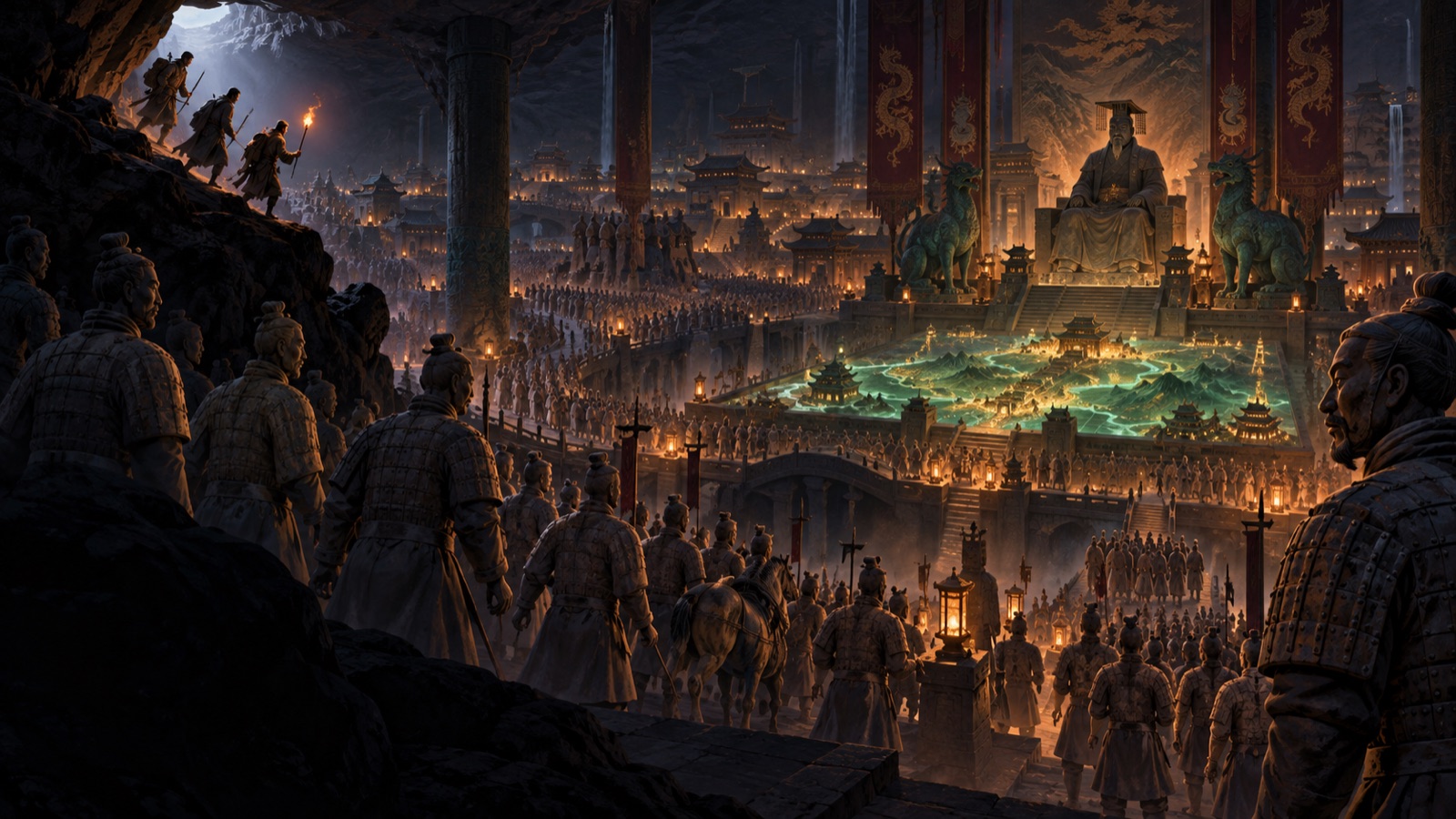
Inspired by The mausoleum complex and Terracotta Army of Qin Shi Huang
The Terracotta Emperor
The guide knows the tomb too well, and the army has noticed what the party took.
What the party believes
The characters meet in a crowded bar outside Xi'an, where a retired surveyor talks about a sealed room beyond the known Terracotta Army pits. Their own search has already led them to the same rumor. A jade command tally connected to their quest may be hidden there. The next morning they hire a quiet guide named Ying Zheng, who arranges research access and seems amused by their interest in the emperor's tomb.
The public galleries feel normal at first. Then one warrior seems to be looking directly at them. A figure beside a doorway appears on the other side when they look back. Farther down, an entire row has changed its stance. Ying Zheng calls it poor lighting and leads them toward a maintenance corridor that does not appear on the site plans.
Find the undiscovered chamber, recover the jade command tally, and get out before the site closes around them.
Where the trail leads
- Follow fresh clay footprints into a passage that staff insist has been sealed for decades.
- Watch one warrior vanish from its row and reappear ahead of the party with a hand resting on its sword.
- Enter a hidden treasury where bronze weapons remain sharp and painted faces track every movement.
- Hear Ying Zheng warn the party about 因果报应, yīnguǒbàoyìng, and the karmic price of taking what belongs to the dead.
- Remove the command tally from the treasure pile, hear the stone doors close, and face thousands of clay heads turning at once.
What actually happened
Ying Zheng is the king who became Qin Shi Huang, the First Emperor of China. His spirit has walked the pits under borrowed names, judging everyone who enters his burial realm. The command tally is part of the authority that binds the Terracotta Army to his tomb. Taking it counts as theft from the emperor himself.
He drops the manner of a guide and speaks as a ruler. The warriors step from their ranks and attack in disciplined formations while Qin Shi Huang takes up a bronze sword and joins the battle. Returning the tally may calm the army, but the characters still have to answer for crossing the tomb's final boundary.
Where it can end
- Defeat Qin Shi Huang and escape with the tally as the army collapses back into clay.
- Return the tally and bargain for safe passage by giving up another treasure or promise.
- Break the tally, freeing the warriors from the emperor and turning the tomb into a civil war of clay.
The history behind the story
Qin Shi Huang's mausoleum includes life size terracotta soldiers, horses, chariots, weapons, burial pits, and architecture arranged around a central tomb. UNESCO describes the plan as echoing the imperial capital. The awakening army, clay bureaucracy, and magical model of China are fictional changes made for the adventure.
Content notes
forced labor, imperial violence, burial spaces. Change or fade any element that does not suit your table.